Check out our coverage of the movie release of The Book Thief! This is part of a series by my friend David Yenoki, who also blogs at cleverbee.org. He had the opportunity to meet the lead actors, the director, and the author of the book on which the movie was based. He will be posting about their interviews over the next few days, so check back again soon!
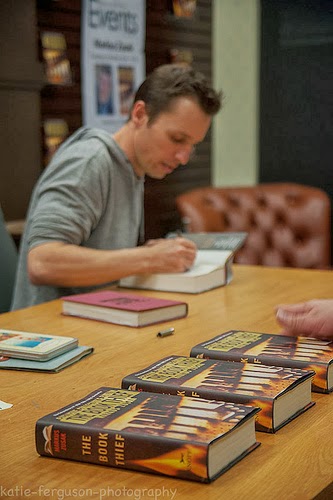
I haven’t read The Book Thief. Well… I haven’t finished it. I did start reading the book, but it’s an intimidating length. And heavy. Full of pages. And full of thoughts.
The Book Thief was written by a charming Australian author named Markus Zusak in 2006. He grew up in Sydney with German and Austrian parents who had immigrated to Australia. His parents’ stories of growing up during World War II provided inspiration for the events written about in The Book Thief, such as stories of cities burning and having to run to bomb shelters during air raids in the middle of the night.
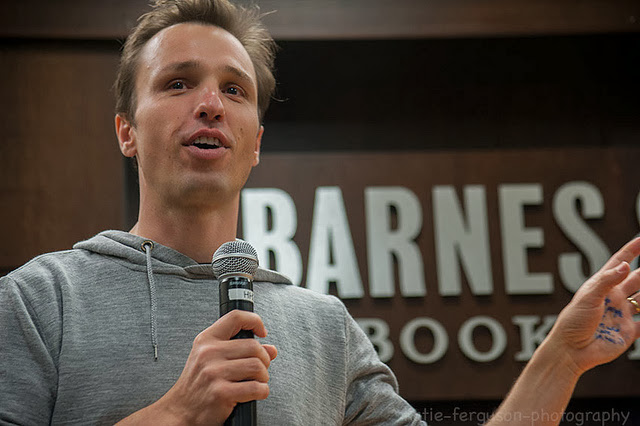
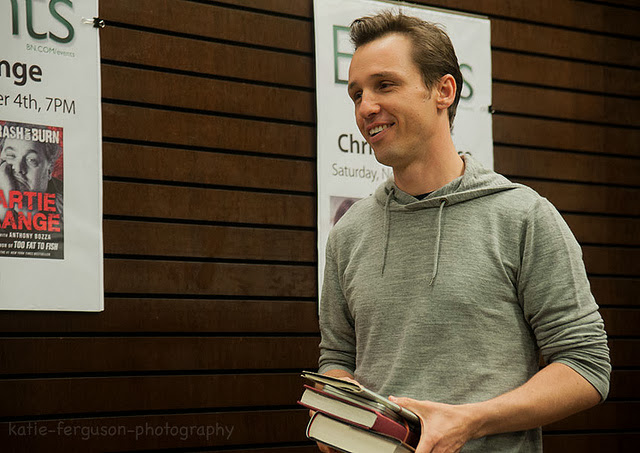
I was lucky enough to attend a talk Markus gave at the Barnes & Noble at the Grove in Los Angeles. He regaled us with amusing anecdotes, including one about his older brother who constantly tormented Markus as older siblings tend to do, and how Markus got revenge by replacing his brother’s hard boiled eggs with raw eggs.
Markus discussed writing and gave us some tips. When he told us about the raw egg prank, he was pulling from personal experience. To be a writer, you don’t need to possess a great intelligence; you just need to do the simple things well. You need to make people believe you when you tell a story: include small details that make the story yours and make audiences believe you. Then he discussed the climax and the unexpected. The climax of the egg prank is not when his brother smashed an egg on his face; instead the audience had the best reaction when Markus told his dad and the audience expects his dad to be upset, but instead his dad is sympathetic and supportive. The last important part of writing was editing. Revision and editing and rewriting. He rewrote the first part of The Book Thief 150-200 times because he believes it makes the writing stronger.
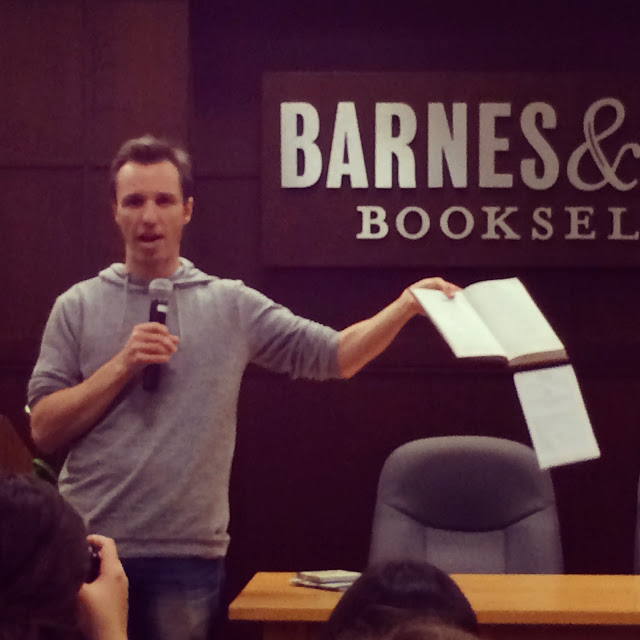
There was a question and answer session where we learned about Markus’ interesting method of writing. He keeps notebooks with him and uses them to make notes. When he starts a book he’ll start by thinking up the beginning and the end of the story. And then in the notebook he’ll make lists of chapter headings. He’ll keep on making these lists and it helps him because he knows what happens in each chapter. “I wish I could write a book that was just chapter headings.” He showed us from a notebook he brought with him.
Early drafts of The Book Thief had narration by an unsympathetic Death character. Having Death as a character made sense because people associate death with war. But this Death started out with a voice that sounded macabre and sleazy. So then Markus tried switching to Liesel narrating the story in first person. He noticed while rewriting that that too had a problem: “Despite having German and Austrian parents, Liesel to me still sounded like the most Australian-sounding German girl in the history of books.”
Next Markus tried writing the story in third person without narration, but that wasn’t compelling enough. He came back to using Death as a narrator but with a twist: “What if Death was actually haunted by us. By humans.” And that’s how the book started to come together. Markus started over yet again and wrote all the way through. (And then revised and revised and revised some more).
Later after the publication of The Book Thief, Markus’ dad had the opportunity to read the book translated in German. His dad read both the English and German texts in parallel to compare and commented: “It’s not exactly that the book is [expletive] in English. It’s just that it’s so much better in German.”
Markus was asked about the The Book Thief film adaptation which he had seen already, and he said that he got very emotional watching the film. He wasn’t directly involved in the production of the film; he reasoned that by imposing opinions and demands on creative people you detract from the art.
“Generally, it’s about how on one hand in that period of time you have Hitler destroying people with words and what you can do with words, and Liesel is stealing the words back and writing her own story with them and it’s a beautiful story.” And he thinks that’s what the film is about too.
I was in a panel with Alethea Allarey of Read Now Sleep Later and we got to talk to the director, Brian Percival, and the actors, Sophie Nélisse and Geoffrey Rush. I’ll get to that later. But in these panels we also got to talk to Markus again and some of this involves spoiler content at the end. So warning, if you don’t know what happens, then stop now, lest the visceral raw emotional content be robbed of your heart when you see the film or read the book.
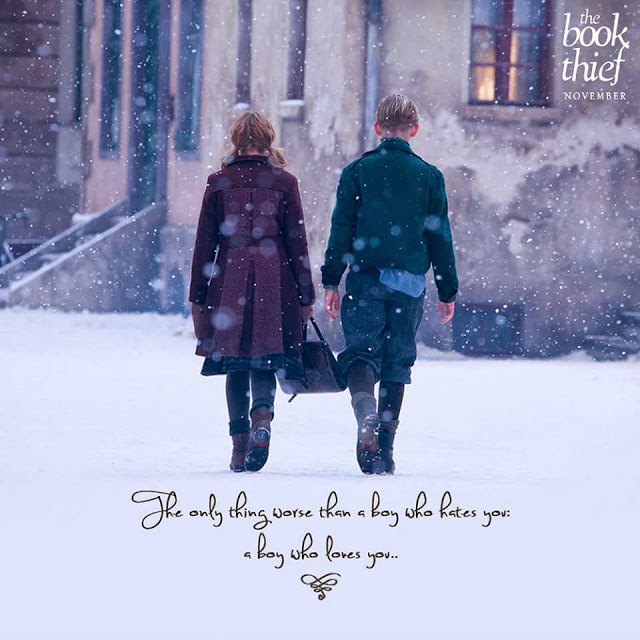
Markus has been asked about happens next after the book and he doesn’t want to write a second Book Thief book. “They say never say never, but I’ll never write Book Thief Part 2.” People will ask or suggest that Liesel and Max get married after the book. They don’t. Markus has at least four reasons why they don’t; the biggest, and what I think the best reason, is that “her real love in the book is Rudy. He’s sort of like a true love for her, to go the whole corny way. And my feeling was if Rudy can’t have her, no one from the world of the book can have her...”
And at the very end I briefly asked a question. One question. Everyone else had left the room. I wish it had been a better question. When the book was originally published in Australia, it was published as fiction. In the United States, The Book Thief can be found in bookstores as Young Adult Fiction and I asked Markus if he knew why there was a difference. His response, and I should have made better notes, was that the United States is the only market that made the choice to categorize The Book Thief as Young Adult. He did explain that if you go into a bookstore in Australia, you’ll find a separation between children's books and adult books. No separate Young Adult section.
I think it’s important to remember that a book can be categorized as (Adult) Fiction in the rest of the world but in this country it might be placed in Young Adult Fiction. And there are people who think that because a book is in Young Adult it will exclude them because they don’t view themselves as young adults. They might miss out on a book that adults around the world in other countries are reading and enjoying and praising because they don’t realize that Young Adult is inclusive, it includes adult readers and younger readers alike. I would like as many people as possible to join me in finishing this book.
For more information, check out the official website www.thebookthief.com
Like the movie on Facebook
Follow @thebookthiefmovie on Twitter
Use the hashtag #TheBookThief on Twitter and Instagram
Based on the beloved bestselling book, THE BOOK THIEF tells the inspirational story of a spirited and courageous young girl who transforms the lives of everyone around her when she is sent to live with a new family in World War II Germany. It stars Geoffrey Rush, Emily Watson, Sophie Nélisse, Ben Schnetzer, and Nico Liersch. It was directed by Brian Percival (Downton Abbey), with a screenplay by Michael Petroni, based upon the novel by Markus Zusak. The film was produced by Karen Rosenfelt and Ken Blancato for Fox 2000.
I haven’t read The Book Thief. Well… I haven’t finished it. I did start reading the book, but it’s an intimidating length. And heavy. Full of pages. And full of thoughts.
The Book Thief was written by a charming Australian author named Markus Zusak in 2006. He grew up in Sydney with German and Austrian parents who had immigrated to Australia. His parents’ stories of growing up during World War II provided inspiration for the events written about in The Book Thief, such as stories of cities burning and having to run to bomb shelters during air raids in the middle of the night.
Markus discussed writing and gave us some tips. When he told us about the raw egg prank, he was pulling from personal experience. To be a writer, you don’t need to possess a great intelligence; you just need to do the simple things well. You need to make people believe you when you tell a story: include small details that make the story yours and make audiences believe you. Then he discussed the climax and the unexpected. The climax of the egg prank is not when his brother smashed an egg on his face; instead the audience had the best reaction when Markus told his dad and the audience expects his dad to be upset, but instead his dad is sympathetic and supportive. The last important part of writing was editing. Revision and editing and rewriting. He rewrote the first part of The Book Thief 150-200 times because he believes it makes the writing stronger.
There was a question and answer session where we learned about Markus’ interesting method of writing. He keeps notebooks with him and uses them to make notes. When he starts a book he’ll start by thinking up the beginning and the end of the story. And then in the notebook he’ll make lists of chapter headings. He’ll keep on making these lists and it helps him because he knows what happens in each chapter. “I wish I could write a book that was just chapter headings.” He showed us from a notebook he brought with him.
Early drafts of The Book Thief had narration by an unsympathetic Death character. Having Death as a character made sense because people associate death with war. But this Death started out with a voice that sounded macabre and sleazy. So then Markus tried switching to Liesel narrating the story in first person. He noticed while rewriting that that too had a problem: “Despite having German and Austrian parents, Liesel to me still sounded like the most Australian-sounding German girl in the history of books.”
Next Markus tried writing the story in third person without narration, but that wasn’t compelling enough. He came back to using Death as a narrator but with a twist: “What if Death was actually haunted by us. By humans.” And that’s how the book started to come together. Markus started over yet again and wrote all the way through. (And then revised and revised and revised some more).
Later after the publication of The Book Thief, Markus’ dad had the opportunity to read the book translated in German. His dad read both the English and German texts in parallel to compare and commented: “It’s not exactly that the book is [expletive] in English. It’s just that it’s so much better in German.”
Markus was asked about the The Book Thief film adaptation which he had seen already, and he said that he got very emotional watching the film. He wasn’t directly involved in the production of the film; he reasoned that by imposing opinions and demands on creative people you detract from the art.
“Generally, it’s about how on one hand in that period of time you have Hitler destroying people with words and what you can do with words, and Liesel is stealing the words back and writing her own story with them and it’s a beautiful story.” And he thinks that’s what the film is about too.
I was in a panel with Alethea Allarey of Read Now Sleep Later and we got to talk to the director, Brian Percival, and the actors, Sophie Nélisse and Geoffrey Rush. I’ll get to that later. But in these panels we also got to talk to Markus again and some of this involves spoiler content at the end. So warning, if you don’t know what happens, then stop now, lest the visceral raw emotional content be robbed of your heart when you see the film or read the book.
Markus has been asked about happens next after the book and he doesn’t want to write a second Book Thief book. “They say never say never, but I’ll never write Book Thief Part 2.” People will ask or suggest that Liesel and Max get married after the book. They don’t. Markus has at least four reasons why they don’t; the biggest, and what I think the best reason, is that “her real love in the book is Rudy. He’s sort of like a true love for her, to go the whole corny way. And my feeling was if Rudy can’t have her, no one from the world of the book can have her...”
And at the very end I briefly asked a question. One question. Everyone else had left the room. I wish it had been a better question. When the book was originally published in Australia, it was published as fiction. In the United States, The Book Thief can be found in bookstores as Young Adult Fiction and I asked Markus if he knew why there was a difference. His response, and I should have made better notes, was that the United States is the only market that made the choice to categorize The Book Thief as Young Adult. He did explain that if you go into a bookstore in Australia, you’ll find a separation between children's books and adult books. No separate Young Adult section.
I think it’s important to remember that a book can be categorized as (Adult) Fiction in the rest of the world but in this country it might be placed in Young Adult Fiction. And there are people who think that because a book is in Young Adult it will exclude them because they don’t view themselves as young adults. They might miss out on a book that adults around the world in other countries are reading and enjoying and praising because they don’t realize that Young Adult is inclusive, it includes adult readers and younger readers alike. I would like as many people as possible to join me in finishing this book.
For more information, check out the official website www.thebookthief.com
Like the movie on Facebook
Follow @thebookthiefmovie on Twitter
Use the hashtag #TheBookThief on Twitter and Instagram
Based on the beloved bestselling book, THE BOOK THIEF tells the inspirational story of a spirited and courageous young girl who transforms the lives of everyone around her when she is sent to live with a new family in World War II Germany. It stars Geoffrey Rush, Emily Watson, Sophie Nélisse, Ben Schnetzer, and Nico Liersch. It was directed by Brian Percival (Downton Abbey), with a screenplay by Michael Petroni, based upon the novel by Markus Zusak. The film was produced by Karen Rosenfelt and Ken Blancato for Fox 2000.