by Vicki Oransky Wittenstein
Lerner/Twenty-First Century Books (October 1, 2013)
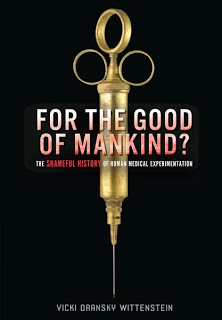
Today, as part of the For the Good of Mankind Blog Tour, author Vicki Oransky Wittenstein stops by to answer a few questions.
FOR THE GOOD OF MANKIND was fascinating to read. I appreciated how you made readers think about the implications of the research. What drew you to this topic and what made you want to write this book?
I was appalled by the experiments . . . yet riveted. Many of the unethical experiments horrified me . . . yet they drew me in. With some digging, I uncovered numerous examples (too many) where people suffered pain, injury, humiliation, and even death. No question about it, the experiments paved the way for great medical advancements. But in the process, people’s individual rights were violated, many of whom did not give consent. Before the 1980’s, when laws were finally enacted to protect subjects, medical researchers took advantage of whomever they could—orphans, prisoners, the mentally ill and African Americans—people who were powerless to speak out, whether from lack of education, poverty, or simply because their social status deemed them “unimportant.”
How was it possible that I had not known about these experiments before? I asked my family and friends. Most people knew about the Nazi experiments on concentration camp inmates during World War II and the Tuskegee syphilis experiments. But like me, few knew about the long history of human medical experimentation dating back to ancient times. Many had read about the pharmaceutical industry’s clinical trials that are so prevalent today, but again, few had thought about the ethical implications of these trials and other human medical experiments in developing areas of medicine, such as genetic therapies, DNA sequencing and stem cell research.
I was curious about why the unethical experimentation was permitted. What events occurred throughout history that reflected and changed society’s view of medical science? So, for example, during the years of slavery, doctors freely experimented on African American slaves who were bought just for the purpose of medical experimentation. Later, medical ethics fell by the wayside during times of war when the U.S. government had to amass huge numbers of troops and prepare them for combat. And during the Cold War, the government created a climate of secrecy. Many people were unknowingly exposed to experiments with radiation, such as the eighteen random patients in hospitals across the country whom Manhattan Project doctors injected with plutonium.
I wanted readers to understand this history, debate the ethics, and learn from our past mistakes. Like most things in life, ethical human medical experimentation requires a balance. How can we pursue society’s goal of medical advancement without stepping on the individual’s right to be free from harm? Young readers today will be the future leaders in law, government, medicine and science. They will be hit from all sides with ethical questions, and they will have to act with fairness and justice. I hope the book challenges them to stand up for what they believe in.
Your book just recently came out. Have you had a chance to do any school visits yet? What type of feedback have you received from teachers (if any)?
I haven’t visited any schools yet, but just a couple of weeks ago I was invited to speak on the nonfiction panel at the New York City Librarian’s Annual Fall Conference for librarians in New York State. Both librarians and teachers were concerned about how to use the Common Core State Standards with their students, and were happy to learn about ways to connect the book to their history and English curricula. Questions at the back of the book provoke critical analysis of each chapter. Additionally, Lerner, my publisher, has suggested student projects and debates that teachers can utilize and link to specific Common Core State Standards (the activities are available on my website and on the Lerner website).
The research behind writing books fascinates me. Listening to where authors found primary and secondary sources, sometimes leads me to ideas that I can use with students in writing exercises. What was the research process like while your worked on FOR THE GOOD OF MANKIND?
The research was fascinating and led to some wonderful interviews. I spoke to several bioethicists, including Jerry Menikoff, M.D., Director of the Office for Human Research Protection, who helped me understand many of the current ethical issues in the field today. I also spoke with Eva Mozes Kor, a twin and survivor of Dr. Joseph Mengele’s experiments on twins at Auschwitz. Her story deeply saddened me. But she also gave me an authentic and meaningful way to discuss a difficult topic with young readers. Similarly, a conversation I had with Joshua Shaw, whose four-year-old brother was flown to the U.S. for treatment, but instead was injected with plutonium, put a human face to a painful story. Today, students can access many primary and secondary sources online, including material from the United States Memorial Holocaust Museum, U.S. Department of Energy hearings on the radiation experiments, the laws promulgated by the U.S. Food and Drug Administration, and many newspaper clippings and journal articles.
Can you share about any future projects that you are working on?
Right now I’m researching a fascinating book for Lerner about the history of reproductive rights in America, abroad, and in developing countries, which will explore the history of birth control and reproductive freedom from ancient herbal concoctions and birth control devices, to 20th Century pioneer Margaret Sanger and the legalization of birth control in the U.S, the invention of the Pill, and the anti-abortion movement. I’m super excited!
Do you have a favorite independent bookstore that you like to visit?
(If you have a link to the store's website that would be great.)
I have two favorite independent bookstores in New York City. BookCourt (www.bookcourt.com) is in Brooklyn, and the Bank Street Bookstore (www.bankstreetbooks.com) is located in Manhattan.
Can we get a glimpse at your TBR (to-be-read) pile? Anything that you are most excited about reading next?
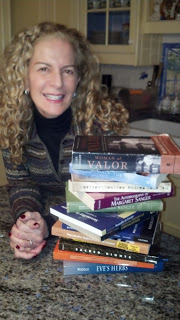
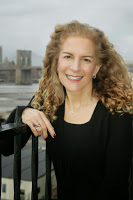
Here I am with my pile—lots of books on the history of reproductive rights!
Thanks for hosting me, Alyson.
About the author: VICKI
ORANSKY WITTENSTEIN has always been curious about new ideas, people,
and places. That curiosity has taken her life in many different
directions. So far, she has been a student, a criminal prosecutor, a
writer, and an advocate for children and families. She is the author of
a number of science and history articles for young readers, as well as
the book Planet Hunter: Geoff Marcy and the Search for Other Earths,
which won the 2013 Science Communication Award from the American
Institute of Physics. She lives with her family in Brooklyn, New York.
For more information, and for a free discussion guide, visit
http://vickiwittenstein.com/.
On
Facebook | On
Twitter
Follow the Blog Tour:
Mon, Nov 4
|
proseandkahn
|
|
Tues, Nov 5
|
The Prosen People
|
|
Thurs, Nov 7
|
The Nonfiction Detectives
|
|
Fri, Nov 8
|
Growing with Science
|
|
Mon, Nov 11
|
Ms. Yingling Reads
|
|
Tues, Nov 12
|
Through the Wardrobe
|
|
Wed, Nov 13
|
Kid Lit Frenzy
|
|
Thurs, Nov14
|
GreenBeanTeenQueen
|
|
Fri, Nov 15
|
The Fourth Musketeer
|
|
We are happy to give away one copy of
For the Good of Mankind (US mailing addresses only). To enter complete the form below.
a Rafflecopter giveaway
Don't forget to link up your nonfiction reviews: