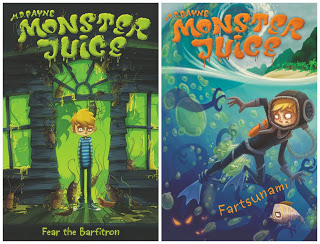
Monster Juice Guest Post by M.D. Payne


For Halloween, I have a special guest post by M.D. Payne, author of the Monster Juice Series (Penguin, August 2013).  He tells us what it was like to write for Middle Graders.  Thanks M.D. Payne for stopping by Kid Lit Frenzy.

Imagine that you were a building a house. You walk up to the beautiful acre you’ve just purchased, ready with every imaginable material—and a dozen burly workers—to get started. You’re ready to go, but before you can, the town authorities pay you a visit.

“We’re so sorry, Mr. Payne,” they say, “but regulations state you can’t actually use that type of wood. Oh, and those colors of paint are going to have to go. Ooooh, and would you hand me that hammer? It’s far too big. You’re limited to five fireplaces and one toilet, or you could have two toilets and three fireplaces. It’s your choice. Also, we’ll need to take any of your workers who are over 120 pounds. You can only keep the four smallest workers. Great! See you later. Have fun building your new house.”

You stand there, in shock and horror, wondering how on earth you’re going to build your dream home with just 1/3 of the material and help. You turn to your workers (who, by the way are in equal shock, as they’ve just been called out as the smallest), and the five of you shrug.

You’ve just got to get started.

This is exactly how I felt diving into the Monster Juice series. When you’re writing for 8-10 year olds, you’ve got less material (words, sentences, even story ideas) to work with than when you write for adults or even older kids. You can become quite limited, not only by plain words, but by streamlined plot devices. You can’t confuse the reader or they’ll slam the book shut, but you still need to keep the story going—and interesting.

The first outline I sent my editor for the series was warmly received (clearly, or I wouldn’t be here writing about my new books), but I remember him telling me, “there’s just too much going on here. You’re going to make their heads spin. You’ve got to focus on a few things and flesh those out.”

I was shocked. My number one worry was that there wasn’t enough going on—I never thought that I would be told that it was too much. And, the funny thing is, I understood I’d have to be careful about words. I had just forgotten that I had to be simpler in every aspect—including with my storyline. I had to keep things entertaining and straightforward—if I strayed from the main path, I might not have readers left when I get back on it.

On the other hand, what I lost in words, sentences and story ideas, I gained in two key tools: the hilarious mixing of horror and humor, and the ability to gross-out. Writing Monster Juice brought me back to my time in middle school, when Young Frankenstein was my favorite movie, and the first goal of one summer was to mow enough lawns to buy The Addams Family on VHS. I got to release my inner boy, and I had forgotten what a gross little monkey he was. He delights in a well-placed fart or inappropriate burp, something fueled by years of watching Ren and Stimpy, for sure.

And, don’t get me wrong—I’m not talking about dumbing things down, here. First, I had to learn the limitations of my audience, and then I pushed them a little farther. My overall goal for this series has always been to get reluctant readers in the door and absorbing more complex ideas and words than they thought possible. Once I got my readers hooked with the farts and barf, wouldn’t they be more likely to take in a larger word or more complex thought without blinking, because they were having so much fun?

So, after my initial frustration of feeling like a Picasso with only 1/3 of my palate, I dove in and had a hilariously marvelous time.

In that time, I’ve placed a number of post-it notes on my computer, my desk, my wall (practically everywhere but on my 14 month old baby, but I’ve thought about it). But there are two that are front and center, right in front of my eyes, always vying for attention. One states “Keep it SIMPLE.” The other states “SCARIER. FUNNIER. SPOOKIER. GROSSER!”

These are my main goals as I build the Haunted House that is Monster Juice.

Official Book Trailer for Monster Juice: Fear of the Barfitron


For more information about M.D. Payne: twitter | website
Nonfiction Picture Book Wednesday - Randolph Caldecott: The Man Who Could Not Stop Drawing


The day before Halloween and I know that I probably should be doing a Halloween Nonfiction Picture Book post, but I finally got my hands of Leonard S. Marcus' Randolph Caldecott: The Man Who Could Not Stop Drawing and just had to share this book with you.

Author/Illustrator: Leonard S. Marcus
Publisher: Farrar, Strauss, & Giroux (August 27, 2013)
Audience: 4th to 7th graders and beyond
Source: Purchased Copy
Biography * Nonfiction * Illustrators * England

Description from GoodReads:
Randolph Caldecott is best known as the namesake of the award that honors picture book illustrations, and in this inventive biography, leading children’s literature scholar Leonard Marcus examines the man behind the medal. In an era when the steam engine fueled an industrial revolution and train travel exploded people’s experience of space and time, Caldecott was inspired by his surroundings to capture action, movement, and speed in a way that had never before been seen in children’s picture books. Thoroughly researched and featuring extensive archival material and a treasure trove of previously unpublished drawings, including some from Caldecott’s very last sketchbook, Leonard Marcus’s luminous biography shows why Caldecott was indeed the father of the modern picture book and how his influence lives on in the books we love today.

My thoughts on this book:
Last year, I participated in a Caldecott Challenge where I read every Caldecott winning book and as many of the honor books that I could find.  However, I realized as I began to read Randolph Caldecott: The Man Who Could Not Stop Drawing by Leonard S. Marcus that I knew little about the man whose name is associated for one of the most prestigious honors to bestowed on an illustrator of children's books.

Randolph Caldecott (1846-1886) was born, raised, and lived in England during the 1800's.  Despite his amazing contribution to the world of children's books, Caldecott himself would not be eligible for the award that bears his name. 

Terms and Criteria (taken from the ALA website):
  1. The Medal shall be awarded annually to the artist of the most distinguished American picture book for children published by an American publisher in the United States in English during the preceding year. There are no limitations as to the character of the picture book except that the illustrations be original work. Honor books may be named. These shall be books that are also truly distinguished.
  2. The award is restricted to artists who are citizens or residents of the United States.  Books published in a U.S. territory or U.S. commonwealth are eligible.
  3. The committee in its deliberations is to consider only books eligible for the award, as specified in the terms.
I found that to be somewhat sad.  It was amazing to read about his contributions to the world of children's literature and thankful for the ways that he inspired both illustrators and librarians. However, I couldn't help wonder what Caldecott would think of the criteria.

Anyway, I digress.  Back to my thoughts on the book.  Marcus does a remarkable job writing an in-depth biography of Caldecott in the format of a children's picture book.  The text is substantial.  This is no lightweight story.  Readers learn of Caldecott's early years, his career in the bank (at the young age of 15), and his eventual rise to a sustainable & profitable position as an illustrator, which was rare in those days.  In addition to excellent biographical information, the book also contains original artwork by Caldecott and by others of his time.  It shows the influences that would have impacted Caldecott as he began his career as an illustrator.  I was amused to note that on the books that Caldecott created that it would say "One of R. Caldecott's Picture Books".

Despite Caldecott's natural charisma, sense of humor and amazing talent as an illustrator, he was plagued through his life with poor health and a heart condition from an illness as a child.  As a result, the world did not fully get to witness what Caldecott may have become if he had had more time.  Caldecott died during a trip to Florida in 1886 just a month shy of his fortieth birthday.

If you are a fan of children's picture books, then you will want to add this book to your personal collection.  It would also be a wonderful addition to a classroom or school library. Look for a copy of Randolph Caldecott: The Man Who Could Not Stop Drawing at your local library or independent book store.         

Randolph Caldecott: The Music Video - This is a couple of years old but still great.


The Caldecott Medal 75th Anniversary Logo designed by Brian Selznik:


Don't forget to link up your nonfiction reviews:

Cover Reveal: Fragile Brilliance by Tammy Blackwell

FB CROP 

Today is the cover reveal for Fragile Brilliance (Shifters and Seers #1) by Tammy Blackwell!

Fragile Brilliance Cover lr

Maggie McCray has worked her whole life for the opportunity to attend Sanders College. It’s her one chance at becoming a world-renowned artist, and she’s determined nothing will get in her way. But when a murder brings Maggie and her powers to the attention of the Alpha Pack and the tragically handsome Charlie Hagan, her carefully planned future hangs in jeopardy.

Charlie Hagan isn’t happy when the Alpha Female assigns him as Maggie McCray’s personal bodyguard. Just being near the Thaumaturgic threatens to unleash the primal instincts he’s been suppressing for so long. Charlie knows if the coyote is uncaged, then the person he’ll most need to protect Maggie from is himself.

Fragile Brilliance is the first book in the Shifters & Seers series by Tammy Blackwell, bestselling author of the Timber Wolves trilogy.  It releases on Tuesday November 26, 2013.  Add it your want to read list on Goodreads.
About Tammy Blackwell
Tammy Blackwell

Tammy Blackwell is a Young Adult Services Coordinator for a public library system in Kentucky. When she's not reading, writing, cataloging, or talking about books, she's sleeping.

It's Monday! What are you reading? From Picture Books to YA - 10/27/13


It's Monday! What are you reading? is hosted by Sheila of Book Journey.  Jen from Teach Mentor Texts and Kellee from Unleashing Readers have adapted it to focus on Picture Books to Young Adult Books.

My last two weeks were insane.  Some of you know that a good friend of mine had to have emergency heart surgery.  During the time that he was in the hospital, I stepped in to help care for his three children so his wife could spend much of her time at his bedside.  I am excited to say that he came home today.  The long road to recovery continues, but we are thrilled by his progress to date.  Unfortunately, much of my time for free reading disappeared.

Here is what I have been able to squeeze in. 


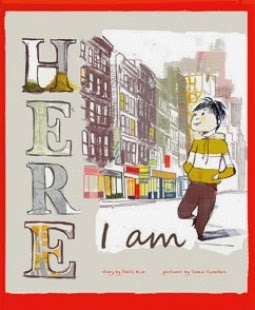
Here I Am story by Patti Kim; Illustrated by Sonia Sánchez (Picture Window Books, July 1, 2013) - A wordless picture book that looks at the immigrant experience.


Daisy Gets Lost by Chris Rascka (Schwartz & Wade,  October 8, 2013) - Rascka's follow-up to A Ball for Daisy is really fun.


The Invisible Boy by Trudy Ludwig; Illustrated by Patricia Barton (Knopf Books for Young Readers, October 8, 2013) - A story of differences and friendship that will be a great discussion starter.


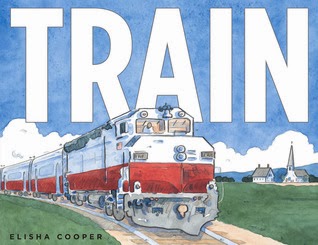
Train by Elisha Cooper (Orchard Books, September 24, 2013) - Fans of Cooper will enjoy her latest book about commuters on a train.


No More Independent Reading Without Support by Debbie Miller, Barbara Moss; Edited by Nell K Duke, Ellin Oliver Keene (Heinemann, 2013) - This has some great stuff in it and it isn't a long read.  I am eager to share this with my Literacy PLC.


The Next Step to Guided Reading: Focused Assessments and Targeted Lessons for Helping Every Student Become a Better Reader by Jan Richardson (Scholastic, 2009) - I was doing some refresher reading on Guided Reading.

What I am excited to read with my ears this week:


Fortunately, The Milk by Neil Gaiman (HarperCollins, September 17, 2013)


From Norvelt to Nowhere by Jack Gantos (MacMillan, September 24, 2013)

So, what are you reading?

Common Core IRL: In Real Libraries - The Day of the Dead/El Día de los Muertos


It's time for another installment of  Common Core IRL: In Real Libraries.  This time we are doing something a little different.  Since Halloween is fast approaching, we decided to focus on scary stories, and other related topics.  Being in Southern California, I decided to talk about Día de los Muertos or Day of the Dead which is celebrated on November 1st and 2nd. 

Don't forget to check out the other posts as part of this series, and see what everyone has for you

     * Louise Capizzo, children’s librarian & Cathy Potter, school librarian: The Nonfiction Detectives
     * Mary Ann Scheuer, school librarian: Great Kid Books
     * Travis Jonker, school librarian: 100 Scope Notes

Check out the following picture books and app for use with Pre-K to 2nd grade.

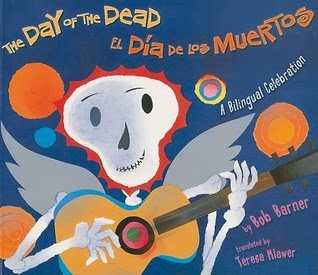
The Day of the Dead/El Día de los Muertos
Author/Illustrator: Bob Barner
Translated by: Teresa Mlawer
Publisher: Holiday House (2010)
ISBN: 978-0823423811
Read Aloud: Pre-K to 2nd grade
Independent Reading Level: High 1st grade to 3rd grade.
Language: English and Spanish
Source: Purchased

My thoughts on this book:
When I was working at a school site with a Dual Language Immersion Program/Spanish, we used this book as part of our learning about The Day of the Dead in our younger classes.   Text is written in both English and then also shown in Spanish.

This is one of my favorite picture books for explaining about the Day of the Dead for younger students.  It simply explains what the Day of the Dead is and how it is celebrated.  The author provides notes about the Day of the Dead at the end of the book.  The illustrations are bright, and reflect the culturally aspect of the story.
 

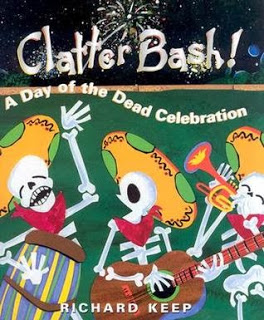
Clatter Bash!: A Day of the Dead Celebration
Author/Illustrator: Richard Keep
Publisher: Peachtree Publishers (2004)
ISBN: 978-1561454617
Read Aloud: Pre-K to 2nd grade
Independent Reading Level: Kindergarten to First grade
Source: Purchased

My thoughts on this book:
Clatter Bash! is designed for younger readers.  The story is told through the use of very rhythmic sounding words with some Spanish words interspersed throughout the pages.  The perspective of the story seems to be more from the skeletons who are celebrating the holiday.  Children would need some explanation as to why the skeletons are having a party. 

Though the text of the book is simple, the endnotes provide readers with a nice explanation of the Day of the Dead and the various symbols related to the day.  The illustrations in the book are colorful and very festive.  The use of color and style fit well with the origins of this holiday.


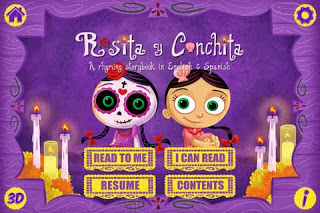
Rosita y Conchita: A Peek 'n Play Story App
by Mobad
Released: October 25, 2012
Language: English and Spanish
Devices: Designed for both iPad and iPhone

My thoughts on this book app:
This book app tells the story of twin girls, Conchita and Rosita.  One of the twins has passed away.  As Conchita seeks to remember her sister Rosita, readers are led through the various preparations and activities that families go through as part of remembering and honoring the dead.  

Though some parents may be concerned about sharing a story with young children about the death of a sibling, this is sensitively done in a way that helps younger children understand what the Day of the Dead is all about.  Parents and teachers should review the app prior to sharing it with students in case there are any individual concerns that need to be considered.

The app allows readers to either hear the story being read or to read the story on their own.  The story can be read in either English or Spanish.  Children also learn about how to make sugar skulls, and learn how to draw Rosita at the end.   The illustrations are colorful and reflect the art of the holiday.
  

How to incorporate this into the Common Core State Standards:
There are multiple way these texts can be integrated into the Common Core Standards; however, one suggestion would be to look at how two different texts can be similar and different, and to discuss the relationship between text and illustrations (Integration of Knowledge and Ideas). 

Don't forget to link up your nonfiction reviews...