International Dot Day 2013


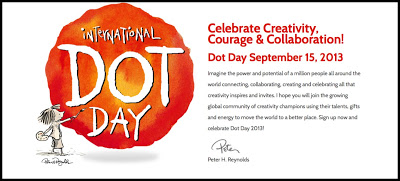
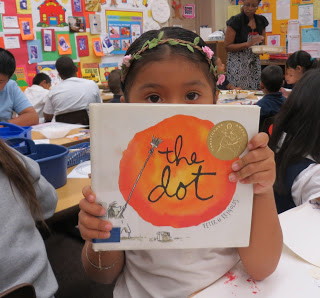
Each year, I share information about the annual International Dot Day celebration and activities with teachers.  I hope that when a teacher sees the information and he or she will get excited about participating in this annual celebration.  This year, two teachers decided to join in.  On Friday, September 13th, I went up to Altadena Elementary to hang with Ms. Camargo's fourth graders and Ms. Major's kindergartenters as they celebrated Dot Day together.


These two great teachers paired their students together for the reading of Peter H. Reynold's book, The Dot.

  
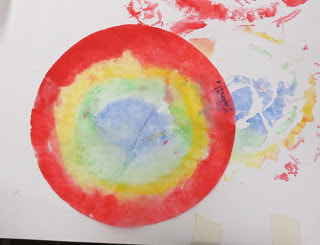
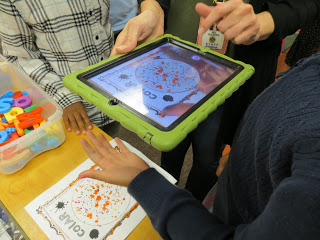
Then the two classes paired together for a variety of activities to celebrate Reynold's book and it's message of creativity and collaboration. 


Enjoy the video of their Dot Day celebration!


Thank you Ms. Camargo and Ms. Major for running with this idea and sharing it with your students.

The Great Trouble Review & Blog Tour

Author: Deborah Hopkinson
Publisher: Knopf (September 10, 2013)
Source: Copy for Review
Audience: Grades 5th to 8th
Keywords: Historical Fiction, Europe, 1800's, Epidemics

Description of the book:
Eel has troubles of his own: As an orphan and a "mudlark," he spends his days in the filthy River Thames, searching for bits of things to sell. He's being hunted by Fisheye Bill Tyler, and a nastier man never walked the streets of London. And he's got a secret that costs him four precious shillings a week to keep safe. But even for Eel, things aren't so bad until that fateful August day in 1854—the day the Great Trouble begins. Mr. Griggs, the tailor, is the first to get sick, and soon it's clear that the deadly cholera—the "blue death"—has come to Broad Street. Everyone believes that cholera is spread through poisonous air. But one man, Dr. John Snow, has a different theory. As the epidemic surges, it's up to Eel and his best friend Florrie to gather evidence to prove Snow's theory before the entire neighborhood is wiped out. Part medical mystery, part survival story, and part Dickensian adventure, Deborah Hopkinson's The Great Trouble is a celebration of a fascinating pioneer in public health and a gripping novel about the 1854 London cholera epidemic. Backmatter includes an author's note, time line, and further reading suggestions.

My thoughts:
When I read a book, I have a checklist in my head to determine if I liked it and why.  The checklist for Deborah Hopkinson's newest book The Great Trouble would look a little like this:

      Historical Fiction that makes you want to know more about the subject.  -  check
      Description of the setting that makes you actually feel like you experienced it.  - check
      Characters that your care about and would want to know (or not).  -  check
      Mystery and intrigue.  - check
      Book that sucks you in and you can't put down.  -  check

Yes, this book has it all.  As a 5th grader, I would have been thoroughly fascinated with Eel (the main character), the setting of London in 1854, and what was happening at the time to the individuals of this city as a result of the Cholera epidemic.  I guess the adult me is still intrigued by the same things.  Since no one seems to have created a machine which would allow me to travel through time, I will have to travel to different time periods through books.   And when you think about it, travel through books has its advantages. 

In The Great Trouble, Hopkinson from the beginning paints a very real picture of life for the poor and working class of Victorian London.  It is really not a great place to be in some ways.  Most of the time there is not enough food or clean water.  The sewage and waste disposal system was - well non-existant, and it really was a smelly place.  Aside from making me appreciate modern bathrooms, plumbing, and sewers,  I was really thankful for my life versus the life of many people during that time period. 

Hopkinson then introduces readers to the very real concern of cholera and disease during that time period.   She also has created memorable fictional characters such as Eel, his best friend Florrie, Thumbless Jake, and Fisheye Bill Tyler, and paired them with the very real Dr. John Snow, Jane Weatherburn (Dr. Snow's housekeeper), and Rev. Henry Whitehead.   There are characters that you love, and ones that you will emotionally feel for, and ones that you just plain won't like.  It is the emotional connection to the characters that also fuels the readers interest in these individuals, and in their plight.

By adding in the race to discover what causes cholera as well as what is causing the spread of cholera, readers have a gripping story that will keep them reading.  At the end of the book, readers can learn more about the actual historical figures in the book by reading the author's note.  There is also a timeline, and additional resources to investigate.

Look for The Great Trouble at your local public library or pick up a copy at your community bookstore.  When possible, please consider an independent bookstore.   

Check out this Meet the Author video by AdLit:


Find out more information about author, Deborah Hopkinson visit her website:  www.deborahhopkinson.com


Consider pairing the picture book A Boy Called Dickens by Deborah Hopkinson (see my review here)  with The Great TroubleA Boy Called Dickens is set in a London, though a bit earlier than 1854, and the illustrations provide students with a visual and a sense of place for that time period.  Adult readers looking for more information about the Cholera Epidemic and Dr. John Snow might want to check out The Ghost Map by Steven Johnson. 

If you are interested in the Teacher's Guide, click here.

To visit all of the stops for The Great Trouble Blog Tour, see the schedule below:
September 10 – Sharp Read
September 11 – Librarian in Cute Shoes  
September 12Random Acts of Reading  
September 13Styling Librarian  
September 14Kidlit Frenzy  
September 15Busy Librarian  
September 16{Eat the Book} 
September 17Nerdy Book Club

Nonfiction Picture Book Wednesday - No Monkeys, No Chocolate

Author: Melissa Stewart; Allen Young
Illustrator: Nicole Wong
Publisher: Charlesbridge Publishing (August 1, 2013)
Source: Personal Copy
Audience: 2nd to 5th grade
Keywords: Nonfiction, Cacao Plants, Microhabitats

Description from GoodReads:  
Most kids love chocolate, but few of them know that its main ingredient, the cocoa bean, comes from a tree that grows in tropical rain forests. Dual-layer text describes the life cycle of the tree, emphasizing its botanical structures and highlighting the interdependence of the plant and animals such as the pollen-sucking midge, brain-eating coffin fly, and aphid-munching anole lizard. Two wise-cracking bookworms offer meta-textual commentary and humor in this fascinating depiction of a microhabitats survival.

My thoughts on this book:
I love chocolate.  So, of course, a title like No Monkeys, No Chocolate caught my attention.  Stewart, with input from Young,  has effectively combined factual information about cocoa beans with a touch of humor to make an enjoyable read for children.

In addition to the great illustrations, there are several elements to this story.  One element is the headline like sentences that continue across two pages.  Another element is the detailed text that shares how cocoa beans grow in tropical rain forests.  Another element are two funny bookworms that provide humorous commentary on the story.  Finally, there is a build up to the title by a play on the title:  "No midges, No chocolate." "No lizards, No chocolate."

The progression of the story helps readers understand not only the way a cocoa tree grows but also how so many other things like midge insects, leaf-cutter ants, maggots, aphids, lizards, and eventually monkeys all have a part in the successful growth and development of cocoa trees and their seed pods.  Nicole Wong's colorful and detailed illustrations are a beautiful compliment to the text.

This is one book to definitely add to a classroom or school library. Look for this book at your local independent bookstore or library.

Though I couldn't find a book trailer for No Monkeys, No Chocolate, here is a short video from Kew.org that compliments the book:


Don't forget to link up your nonfiction reviews:

It's Monday! What are you reading? From Picture Books to Young Adult - 9/9/13

It's Monday! What are you reading? is hosted by Sheila of Book Journey.  Jen from Teach Mentor Texts and Kellee from Unleashing Readers have adapted it to focus on Picture Books to Young Adult Books.

The two classes that I was taking this summer are finally over.  Things are settling in at work.  And I am slowly getting back into a regular reading pattern.  Here is what jumped out from this week's pile.


Bluffton: My Summers With Buster Keaton by Matt Phelan (Candlewick Press, July 23, 2013) - This was a wonderful biographical/historical fiction story featuring Buster Keaton as a boy.  It is one of my favorites from Matt Phelan.  And it made me want to go out and read a biography on Keaton.


Journey by Aaron Becker (Candlewick Press, August 6, 2013) - This wordless picture book is beautiful and one of my favorites of this year's releases. 


Thomas Jefferson Builds a Library by Barb Rosenstock; Illustrated by John O'Brien  (Calkins Creek Books, September 2013) - I'll be reviewing this in a couple of Wednesdays.  I learned a lot about the Library of Congress from this one.


Here Comes the Easter Cat by Deborah Underwood; Illustrated by Claudia Rueda (Dial Books for Young Readers, January 2014) - This one won't be out for a few more months, but I had a great chuckle while reading this one.


The Dangerous Alphabet by Neil Gaiman; Illustrated by Gris Grimly (HarperCollins, 2008) - I thought I knew most of Grimly's work, so I was excited to find this one.  I am a huge fan of his work and love different twists on the standard picture book.

So, what are you reading?

Online Social Studies Resources for Elementary School Teachers

One of the things that I have observed in teachers is how some educators are very closely connected with their TE's (Teacher Editions) and student textbooks, and others like the freedom to create and explore and develop their own lessons.  Regardless of which style you embrace, there are multiple resources available for free online which allow you to incorporate primary source information and media to any lesson.

In my pursuit to find these resources, I turned to my online PLN.  Thank you to Cindy Minnich, Cynthia Alaniz, Donalyn Miller, Margie Myers, Shawn Weisser, and Susan Dee for your contributions to this list. 

Here are several resources that I have uncovered and I have included the websites below.  I am planning on sharing these with teachers this week. 


AASL’s 2013 Best Websites for Teaching and Learning

Avalon Project

iCivics

Edutopia


Fordham University

Kidsites.com – History (listing of multiple sites to explore)


Library of Congress: Teaching with Primary Sources

Life Photo Archive

National Archives Teachers’ Resources

National Geographic Kids

PBS Learning Media


Smithsonian’s History Explorer

Spartacus Educational

TED Talks (variety of topics)

Time for Kids

Thinkfinity Resources

Wonderopolis

YouTube EDU