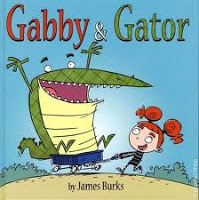
Book Review - Gabby & Gator

Author/Illustrator: James Burks
Publisher: Yen Press (September 28, 2010)
Age Level: 4th to 7th grade (independent reading level) - Enjoyment level 4 to 80
Source: Personal Copy
Rating:  5 out of 5 stars

Description from GoodReads:
Little Gabby doesn't quite fit in with the kids her age. She's more concerned about saving the environment than gossiping with girlfriends. Gator doesn't fit in - well, anywhere really. Flushed down the toilet when he was just a little snapper, Gator's closest friends are probably the dogs in the neighborhood around his sewer home - and he eats them! When Gabby and Gator meet, they find in one another that rare individual who will appreciate them for who they truly are.

Over the past year or so, I have learned some things about publishing.  It seems sometimes publishers make decisions that make it harder to promote a book or get it into the hands of readers.  Additionally, authors, especially new ones, are limited in how much they can say or do about it.  This is where bloggers or reviewers can get involved.  We can get the word out about a book, where to find it, and help get it into the hands of readers.

James Burks debut book, Gabby & Gator, is one of those books.  If you are looking for the book, head straight to your favorite on-line ordering source because with the exception of Borders/Glendale, you will not find it in any local bookstore.  Second, booksellers aren't sure where to list it.  Is it a picture book? graphic novel? Is it for preschool? middle grades? Young adult?  Yes!  It is a bit of all of that.  Let me tell you how I see it....

Burks' Gabby & Gator is a story of friendship, acceptance of individual differences, and empowering children to stand up to bullies. It is funny, quirky, and wonderful on many level.  Burks' illustrations are bright, bold, cartoon-like, and draw the reader into the story.  (I apologize for my lack of artistic terms...what I am trying to say is I enjoyed them.)  Gabby is a little girl who follows a to-do list, eats a vegetarian diet, and recycles.  The others children just don't get Gabby.  Gator is a meat eater, afraid of toilets, and a little sensitive about being considered a monster.  This apparent odd couple meet up and form an unusual friendship.  Their acceptance of one another provides them with the ability to conquer fears and grow.  I laughed while I read it (and lately I needed a laugh) and I never once wondered what the author was trying to communicate.  It's a great book to have in a classroom collection. 

As an educator, I look at a book from the perspective of which students can I give a book to and why.  Burks' Gabby & Gator is essentially a middle grade graphic novel.  Yes, it is hardcover, and yes it has wonderful illustrations, and yes, adults can read it to preschoolers who will laugh and enjoy it.  However, as a picture book for preschoolers, it is technically a little long.  At 100 plus pages, it is about three times as long as a normal picture book (though about as many words if not less on a page than a normal picture book).  So parents will really need to know their child's attention span.  I could see this being difficult to use in a kinder class as a read aloud.

Where I do see it being most effective is with second graders on up.  Teachers could read it with a class as part of a discussion on accepting individual differences or talking about standing up to bullies.  And children within this age group (2nd to 5th) can read the book independently.  For reluctant readers, the limited amount of text will allow for them to read the book and have success and would be a good segue to more formal graphic novels or graphic novel/chapter book hybrids.
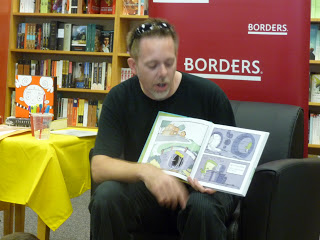
James reading from Gabby & Gator
If I haven't convinced you yet to check out Gabby & Gator, maybe exploring James Burks' webpage and getting a taste of his work will.  For more information about James Burks, check out his website www.jamesburks.com

One final thought on Banned Books Week

As the sun is setting on this year's Banned Books Week Celebrations, I am reminded that challenges and bannings of books continue throughout the year and need out attention and support at all times.  I truly believe that authors who set out to write a great book did not sit around thinking about whether or not their book would be banned.  On the contrary, truly great books are challenged or banned because an author did his/her job effectively.   They were willing to write the story that needed to be told and not to worry about who might be threatened by it.  Instead, they found the courage to share in an authentic manner some aspect of real life that someone would rather not have come to people's attention. 
Vroman's Banned Books Wall
Whether it be books by Judy Blume, Roald Dahl, or Katherine Paterson on the Middle Grade level and Ellen Hopkins, or Laurie Halse Anderson on the YA level, these authors and others like them have made a significant contribution to the lives of children and teens all over.  Their candid, gritty, no holds barred writing styles are embraced by readers young and old alike. 

In conclusion, I just wanted to share a few final links with you.  For those of you who love author Katherine Paterson, I have done a Guest Post over on Mundie Kids.  I explore my thoughts as to why I think she has been one author that is frequently challenged.  To read the post, click here.

Over the past few weeks, I have been awed by the tremendous work of Paul W. Hankins (High School English Teacher) along with authors Laurie Halse Anderson, Sarah Ockler, David Macinnes Gill and many other teachers, librarians, and authors in promoting #SpeakLoudly.  Paul and David have put up a new website called Speak Loudly: Many Voices, One Community.  If you haven't had a chance to check it out, I would encourage you to take a peak.  It will keep you coming back for more.

To conclude Banned Books Week, I want to hear about challenged or banned books that you have read recently and what impact they have had on you.  I will do a random drawing from all those who have left a comment about a favorite Challenged/Banned books & how it impacted you. The winner will receive a free book of his/her choice ($15 U.S. dollars or less) from Amazon or Book Depository.  Contest ends at 11:59 p.m. PDT on October 5, 2010.  

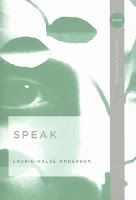
Book Review: Speak

Very few young adult books have come under as much scrutiny and censorship as Speak by Laurie Halse Anderson, yet very few books have also had the transformative power that so many readers, parents, and educators have seen after people read this book. No Banned Books Week celebration would be complete with reference to one of the most popular and controversial debut young adult novels, Speak.


Why was this book banned?
I don't really know why this book was ever banned. While it deals with heavy subject matter, it handles serious issues very tastefully and intelligently. As recently as a few weeks ago, Speak was being challenged again by a Professor Wesley Scroggins, who claims that the novel is "pornographic." For more on this recent challenge, read an extremely well-written article on the author Laurie Halse Anderson's website here: http://madwomanintheforest.com/this-guy-thinks-speak-is-pornography/

I couldn't find a concrete list on the ALA website, but some of the reasons for banning Speak include: Unsuited to Age Group, Sexually Explicit, Violence, Underage Drinking.

What is Speak about?
Speak is about Melinda Sordino, a girl who goes to a "high school party" a few weeks before she starts her freshman year, but when she calls the police to apparently bust up the party for drinking, everyone turns against her and she stops speaking.

She becomes depressed and withdrawn, skipping classes and isolating herself from making friends. Eventually, Melinda finds unlikely solace in her art class, where she can find a release for her emotions. However, there is more that happened that night at the party than what everyone thinks and it will take a lot of strength and courage for Melinda to finally speak up.

Why is Speak worth reading?
I knew what Speak was about before reading it, so much of the surprise about what really happened to make Melinda stop speaking was lost on me, but I still enjoyed the novel. Although the main character, Melinda, doesn't speak, she has very original and vivid thoughts, making her a very interesting character to read about. The writing is also very beautiful and easy to follow.

Most importantly, Speak deals with important issues that aren't always addressed in young adult literature, and is a definite must-read for both teens and adults, both male and female. The author gives a very honest description of high school life and family life for someone who feels like a loner with no one who understands them, which is something most people probably feel at least once  in their lives. Speak isn't my favorite young adult book, but it is such an important novel and told with such beautiful language, that I still recommend this book to everyone.

-- Renée

Banned Books Week: Writing to Reflect Life

I grew up an only child in a house with parents who did not read books. Sometimes I think I was lucky. Books were seen as benign entertainment and indeed, they were my constant companions. I was free to read anything I wanted, first from the library and later, purchased with my allowance money from the bookstore. My view of the world, of relationships, humanity, came in large part from books.

For example, Ray Bradbury’s 1984 taught me the importance of personal freedom and that books were precious, Anthony Burgess’ A Clockwork Orange shocked me with its violence but then forced me to question the punishment given the offender. In James Leo Herlihy and William Noble’s Blue Denim, I saw how difficult it was for teenagers to deal with an unwanted pregnancy on their own and the importance of parents continually engaged in the lives of their kids. And then there was Shel Silverstein’s The Giving Tree...do we have the right to be selfish just because someone is willing to continually give of themselves?

Each book taught me to think, to question. What if I hadn’t been able to read any of them?

I am an author. When I began writing fiction, I spent a lot of time thinking about how – and if – I should include cuss words, violent acts and sexually romantic relationships, even if they moved the story along. It made me crazy and deadened my writing. Then I read a line in On Becoming a Novelist by John Gardner: “...we measure fictional worlds against the real world.” Good books feel real. They reflect the amazingly rich life that surrounds us in all its beauty and ugliness. It may be that some profanity or a sexual encounter represents a truer example of life than if they were left out.

The thing is...no one knows what it is in a book – which passage or chapter – will provide just the right insight into life that someone wants or needs, perhaps even months or years later. So read! Read everything you can. Laugh, cry, gasp, swoon, throw the book against the wall. When you hold a book in your hand, anything is possible.

Marianne D. Wallace is a published non-fiction writer currently working on young adult and children’s fiction. You can find her on twitter as @penwallace

Book Review: The Perks of Being a Wallfower

Standing on the fringes of life... offers a unique perspective. But there comes a time to see what it looks like from the dance floor.

__________


In honor of Banned Books Week, I'm doing a guest post reviewing one of my favorite books -- and one of the most widely banned young adult books -- The Perks of Being a Wallflower, by Stephen Chbosky.


Why was this book banned?
Honestly, why are any books banned? I'm not a huge fan of censorship. I think books should be available to everyone... at the right age of course. Once a child or person is emotionally and/or physically mature enough to handle the themes of a certain book, I don't think his or her school or library should make it unavailable.

Some of the reasons cited for banning The Perks of Being a Wallflower include: "Homosexuality, Sexually Explicit, Anti-Family, Offensive language, Religious Viewpoint, Unsuited to Age Group, Drugs, Suicide."

What is The Perks of Being a Wallflower about?
The Perks of Being a Wallflower is a young adult novel about a boy named Charlie that follows his freshman year at high school. The novel is told in epistolary form, that is, the whole book is a series of letters Charlie writes about his life to someone he addresses as "Dear Friend." Charlie has never met this person and the reader never finds out who this Friend is.

Charlie is a wallflower. He is shy and sometimes socially awkward, but he meets these two new people, Sam and Patrick, who become his friends and introduce him to new experiences in high school, like going to parties, becoming romantically involved with someone, and driving late at night with the windows down and feeling "infinite." Charlie makes an interesting relationship with a teacher at his school, who makes him read complex literature because he sees potential in Charlie.

Through all of these new people in Charlie's life, he grows up, deals with family issues, and discovers things about himself, all while trying to "participate" more in life.

Why do I love this book?
This book is one of my favorites because of how realistically it portrays people. The book doesn't condemn Charlie and his friends for some of the riskier behaviors they partake in, but it doesn't glorify them either. The Perks of Being a Wallflower really celebrates being special and different in ways that aren't always trendy or cool.

I also love Charlie as a narrator. He's so earnest and genuinely concerned about putting everyone else's problems first that he often overlooks himself and doesn't give himself a chance to live his own life. He's not passive in an annoying speak-up-for-yourself-already! kind of way, but instead he makes it really easy to like him and root for him. I'm so used to reading about characters who act impulsively and don't think about their actions first, so Charlie was a bid departure from that.

The writing is also beautiful. I have a quote underlined or highlighted on almost every other page. Although there is some material suited for older young adults, and the novel explores some sensitive and deep issues, I highly recommend it. If you enjoyed The Catcher in the Rye by J. D. Salinger or any of John Green's books, I think you'll love this one. And now I'll leave you with the last lines of the book (which I love, and won't spoil anything for you):

     I'm not sure if I will have time to write any more letters because I might be too busy trying to "participate."
     So, if this does end up being my last letter, please believe that things are good with me, and even when they're not, they will be soon enough.
     And I will believe the same about you.
Love always,
Charlie

-- Renée