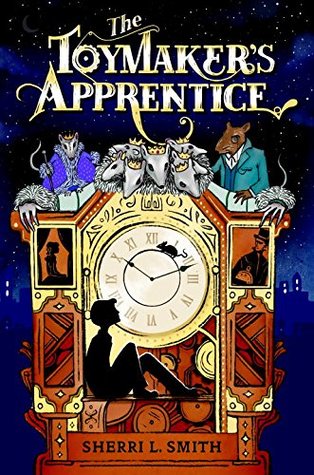
Thank you Sherri L. Smith for stopping by and sharing about your literary heroes as we celebrate your new book THE TOYMAKER'S APPRENTICE. And thank you to Penguin Random House for coordinating the blog tour.
Literary heroes… that’s a tough title to live up to, in part because I find that I learn a lot from all sorts of writers—the ones I think are amazing, and the ones who might not be my cup of tea, but introduce me to a technique, a structure or a way of writing that helps unlock my own work. Probably the first name that comes to mind is Marion Zimmer Bradley. In her fantasy masterpiece, The Mists of Avalon, she did two things that blew me away. One was a broad effect—she retold a very familiar tale about King Arthur, and convinced me that this was the only way it could have happened. Her version of the story, from Morgan Le Fay’s point of view, felt like I was reading the truth. The other thing she did was on a smaller scale. There is a scene in the book where Morgan is weaving and at the same time enacting a spell. The effects of the spell during a boar hunt are intercut with the act of her weaving. It’s something we see in movies all the time, but in writing it was striking. How she kept the rhythm of that moment, and built the tension was amazing to me. It’s something I studied for use in my own work.
For The Toymaker’s Apprentice specifically, aside from the primary inspiration of E.T.A. Hoffman’s story, The Nutcracker and the Mouse King, I looked to another fantasy favorite of mine—David Eddings. In Toymaker there is a rat named Ernst Listz. He’s a scholar and an adventurer, a minstrel and a scribe. Shortly after we meet him, he sings a song in a tavern in exchange for a meal. Writing music into a story can be difficult. In fact, I had an editor once tell me it couldn’t be done successfully. But, clearly, she hadn’t read Eddings’ The Mallorean.
In book three of this fantasy series (which I highly recommend, especially the first series, The Belgariad) there is a scene at a feast where three women, including an immortal sorceress—sing an ancient song about the fall of a city in a great battle. The sorceress was actually there, so her version has great resonance. I first read these books in high school and I remember the breathless effect the scene had on me. Eddings was smart. He didn’t write the song. He wrote the intent. He wrote the feeling of the moment and the effect on the listeners. I leaned heavily on this when crafting Ernst’s song. It has the same sort of history to it. He is singing about the Pied Piper of Hameln. From a rat’s point of view, this is the story of a massacre. You’ll have to read the book to see how I managed it. The one difference is, I did write lyrics, but only the chorus appears in the story. (If you want the rest, it’s there in the appendix.)
Lastly, I’ll credit Lloyd Alexander’s Westmark trilogy with telling me what is possible when telling an historic, or historically inspired, tale. Sweeping stories work, but you have to have heroes you want to be swept along with! At the end of the day, this book is about two motherless boys with great expectations upon their shoulders, and where their loss and ambition leads them, across a landscape where I hope many readers will want to follow!